
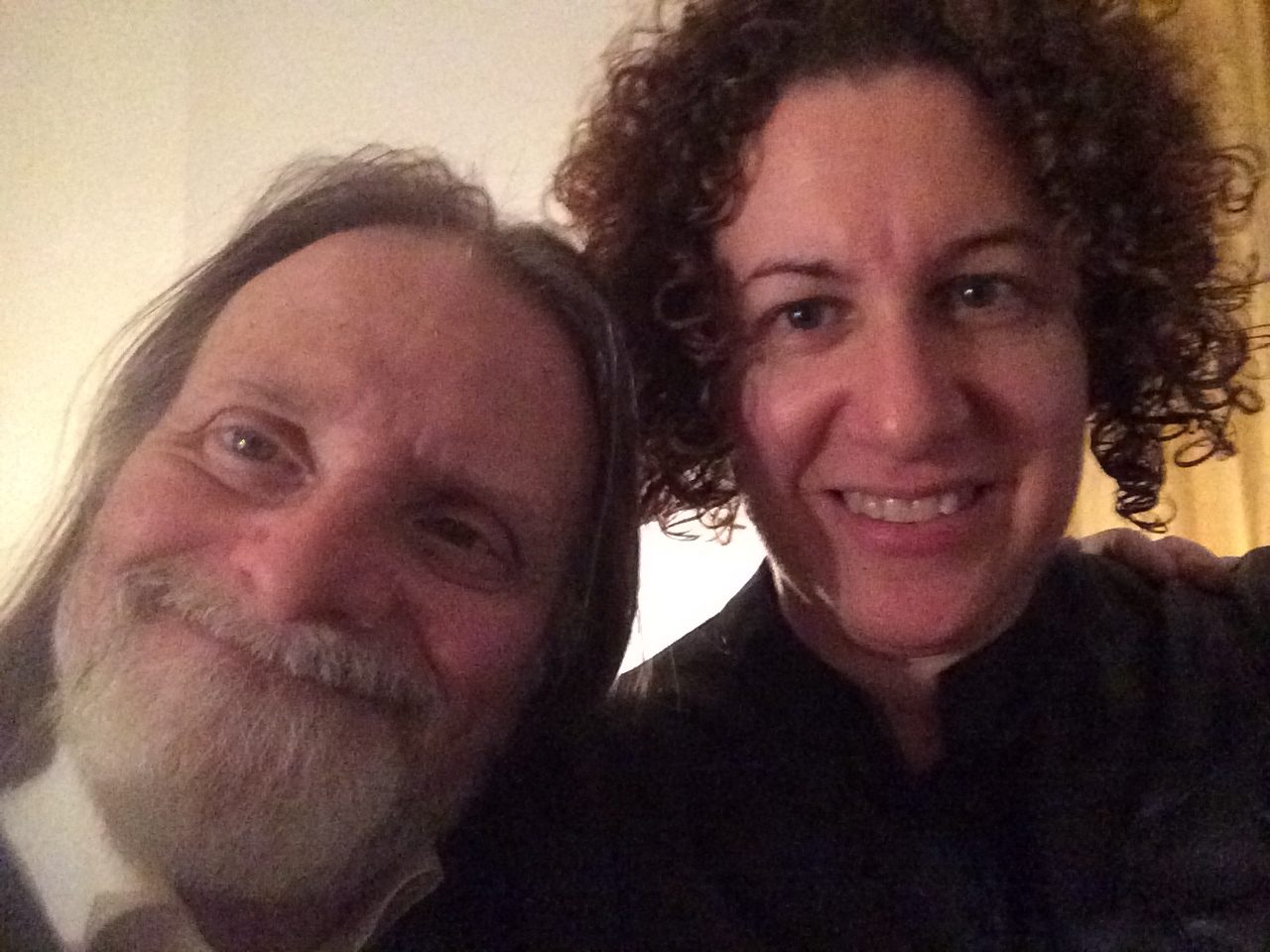
By now you may have heard that Richie Beirach passed away on January 26th. He was a vanishingly rare original voice in this music. We hear words like “genius,” “giant” and “great” so often, their meaning has diminished. These words apply to Richie in their truest sense.
I studied with Richie formally for about six years back in the ‘90s and we became good friends. I remember going to his gigs and recording sessions. They were learning experiences too. After a lesson sometimes we’d go to Wo Hop or the Cuban-Chinese restaurant in Chelsea. Richie introduced me to those restaurants.
Here is some advice he gave me on solo piano. It’s an excerpt from an email he sent me when I was working on my first solo piano album in 2011:
- remember not too much pedal
- don’t bang. Drop your arm. Use your shoulder weight
- develop your ideas stay with one motive as long as you can – smooth transitions from motive to motive
- remember, melodies are most important,, lines connect them,, nobody ever remembers the lines!!! just how they FEEL!!!
- play simple short endings
- love you good luck and play your ass off!! dont let the big motherfucker piano play YOU!!! YOU are the bitch in control!!!!
Richie said so many things that changed how I play and think about music. Something he wrote in an article about five years ago had a profound effect on me:
“You have the right to play what you imagine.“
It sounds like an egotistical statement, but it was actually the opposite. The simplicity of it took all the ego out of playing. I started saying this to myself before playing, and it made my playing much freer and stronger.
Something else he said when I first studied with him that stayed with me was:
“Your compositions should sound improvised, and your improvisations should sound composed.”
As recently as last week, while teaching in Groningen, Amsterdam, I told several students about Richie. I told them to check out his music and that, if he were in better health, I would tell them to get to Germany and take a lesson with him, as I’d told many of my students over the years.
Richie was always supportive, yet he still maintained the highest musical standards. Just “chatting” with Richie was to find yourself inspired to a higher standard and ideal of creativity.
The last musical advice he gave me was in response to a new composition I played for him during a FaceTime call about six months ago. He thought the composition and my soloing on it were very original, but he told me I should find my own left-hand voicings, the way Chick and McCoy (and Richie himself) had.
What a Herculean task! But this was Richie Beirach’s uncompromising standard, that there is always another level to attain and that originality, finding one’s voice, is paramount.
“You have the right to play what you imagine.” Rest in peace, dear friend.
REMEMBERING RICHIE BEIRACH
I first met Richie Beirach in September of 1966. We were both freshman at what at that time was called Berklee School of Music. I was a bass player and we were in some classes together. We started to hang out and eventually had a trio that played a few gigs here and there. The next year we got an apartment together with a drummer and a guitarist on Symphony Road, a few blocks from the school and right up the street from the Boston symphony. All we did was play. We had sessions going on all the time that everyone would come by to. Even some “name” musicians passing through town would occasionally stop by.
It was a magical time to be a young jazz musician. The world of the mid 1960s was exploding with creativity and jazz was in the vanguard of it all, at least that’s the way we felt. Berklee was coming into its own and Boston was filled with so many talented musicians from all over the country and world. Many would go on to have successful careers. I remember Ernie Watts, Harvey Mason, Miroslav Vitous, the LaBarbera brothers, (Pat, John, and Joe), Harvey S. (then Swartz) Calvin Hill, Joe Azzarella, Jack Walrath, Carl Schroeder, Rick Laird, Ronnie Glick, Ronnie Davis, Jerry Bergonzi, Harvey Diamond, Alan Broadbent, Walt Namath, it’s a very long list so I’ll just stop there. Everyone was super charged by the excitement of the times, the zeitgeist of the 1960s.
For me Richie Beirach stood out from the crowd in one very special way. His energy and enthusiasm was just for being a jazz musician and it was so infectious and unique. For him it was as if the whole cosmology of human evolution was progressing towards its one final destination – “homo jazzista”. OK, that’s an exaggeration but you get the idea. If he wasn’t playing music he was listening to music. If he wasn’t listening to music he was talking about it. It was total immersion.
After Berklee I was back in New Jersey but I made a couple of sessions at his parent’s house in Queens just before he got the apartment on Spring St. in lower Manhattan. We hung out a few times there but began to drift apart. By the time he started the band “Lookout Farm” with Dave Leibman, Frank Tusa, and Jeff Williams we had pretty much lost touch. In the early 2000s I saw he had a gig at Birdland so I made it a point to go see him. After some 35 years he barely recognized me at first but then it became a nice reunion nonetheless.
I write this because Richie has a special place for me. I respected him as a musician but we were not always on the same page musically. And I can also attest to some less than admirable qualities to his character. But now that I’m approaching 80 years old and I look back at a life that like so many others, musicians in particular, had many ups and downs, the one thing that I’ve always tried to hold onto is that extraordinary exhilaration of being 18, 19, 20 years old, eating a can of beans for lunch but feeling you’re on top of the world because you are a jazz musician. For me that was Richie Beirach and that was his gift. It was a rare and precious gift and I’m so sorry he’s gone.
Russell Branca
Ozone Park, NY